



Safe Work NSW reports that Australians spend 76% of their work hours sitting. Long periods of sitting can go with a twinge in the lower back, and that discomfort can make ordinary tasks harder.
The Australian Bureau of Statistics reported that around 4 million people, or 16%, had back problems in 2022, about one in six Australians. Painaustralia estimates that by 2050, about 5.23 million Australians may be living with chronic back pain. The World Health Organization reports that 619 million people were living with low back pain globally.
This page sets out the Australian figures the current posts already cite, with their sources, then covers common causes, the role of posture, and how we assess back pain at Continuum Health & Performance in North Strathfield.
Overview of back pain in Australia
Back problems can affect people who sit for long hours and people who do physical work. Pain may come from strained muscles, irritated nerves, or joints from the neck through to the buttocks.
The Australian Institute of Health and Welfare reports that back problems were the third leading cause of disease burden in Australia, affecting around one in six people in 2022.
How common it is
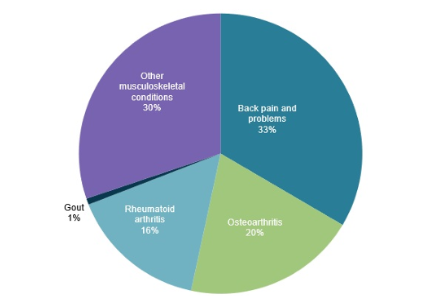
The ABS figure above (around 4 million people, 16%, in 2022) is the main national prevalence number used on this page. Back pain accounted for 34% of illness and disability among musculoskeletal conditions in Australia, according to AIHW 2023.
Musculoskeletal conditions burden (Disability-adjusted life years), by disease, 2023
Source: AIHW 2023
Age and sex
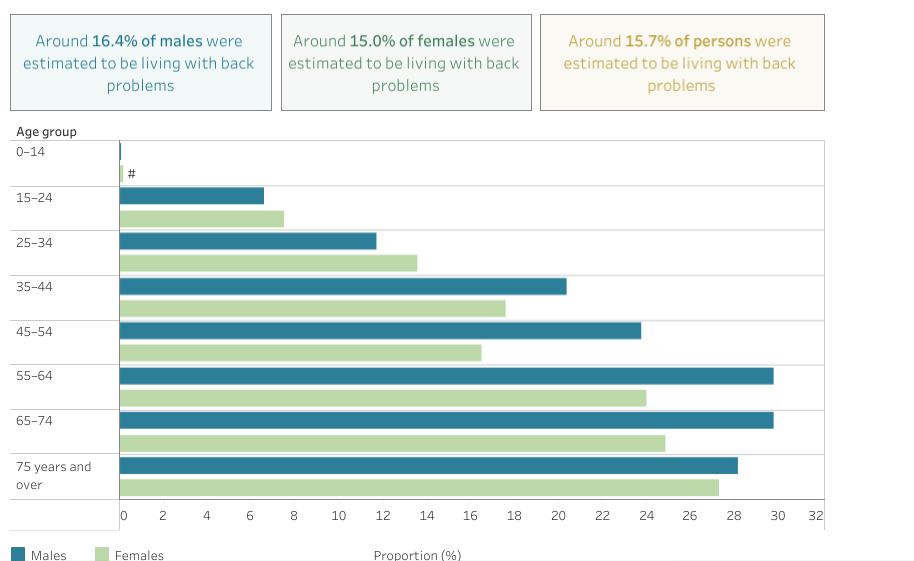
AIHW data show that back problems were similarly common in males and females, and that rates were higher in older Australians, peaking from 55 years. That is a description of the published chart, not a prediction.
Prevalence of back problems by age and sex, 2022
Source: Australian Institute of Health and Welfare
Common causes of back pain in Australia
healthdirect reports that 9 out of 10 back pain cases do not come from a serious medical condition. Causes still vary. A longer look at common causes of lower back pain is on a separate page.
Work
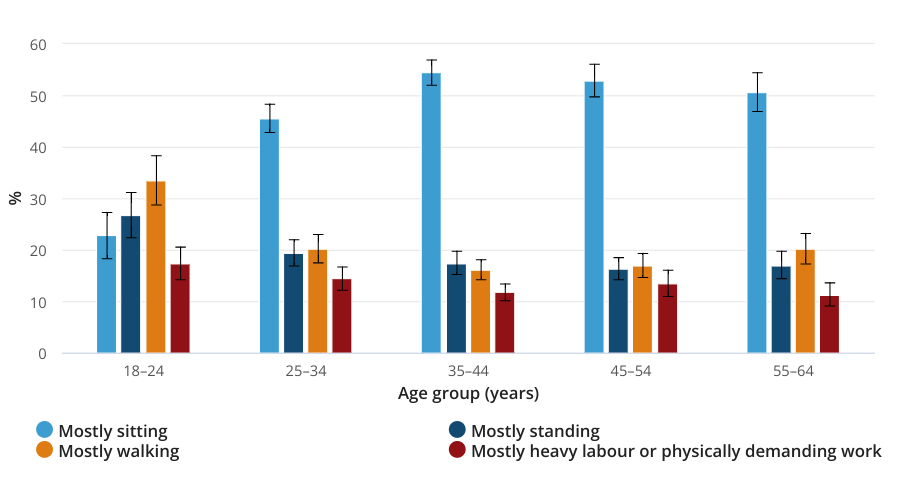
ABS physical activity data for 2022 report that 46.9% of employed Australian adults spend a typical workday mostly sitting, and that this is more common in workers aged 35 and over. A 2024 paper in BMC Public Health reported that sitting for more than 6 hours was associated with a 33% higher risk of chronic back pain than sitting less.
Proportion of adults aged 18 to 64 years by type of activity at work on a typical work day in the last week and age, 2022:
Source: Physical activity, 2022 | Australian Bureau of Statistics
Physical work also matters. The ABS work-related injuries release reports that lifting, pushing, pulling or bending accounted for 24% of work-related injuries. An Australian Pain Society workplace fact sheet lists nursing, construction, warehousing, transportation and landscaping among the jobs with the highest reported back pain rates.
Everyday habits
Long sitting, often at a desk that does not fit you well, can go with a slumped posture and extra load through the back, shoulder blades and spine. Low activity can leave the muscles that support the back under-prepared. Extra body weight adds load during everyday movement. None of these guarantee back pain, and changing them does not guarantee that pain will settle.
Medical conditions
Conditions such as osteoarthritis can affect spinal joints and leave the lower back stiff. Osteoporosis can lead to spinal fractures, which may cause back pain.
If a disc bulges or herniates, it can irritate a nearby nerve. When that nerve is the sciatic nerve, people may feel pain travelling into the leg. A published review reports that around 5 to 10% of people with back pain have sciatica. There is a separate page on how we talk about bulging discs.
The impact of back pain
Painaustralia reports that over 80% of Australians with back problems have chronic pain.
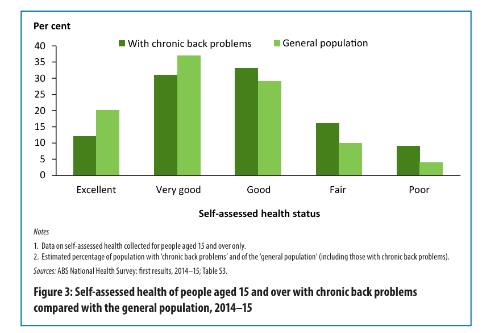
AIHW’s report on the impacts of chronic back problems found that, in 2014 to 2015, around 8.9% of Australians with chronic back problems reported poor quality of life, compared with 4.4% of the general population, and that about 6.8% had high psychological distress, compared with 3.7% of the general public. In 2012, about 1.2 million people (28%) with a disability had chronic back problems. Of those, about 43% had limited activities, and 77% could not work.
Source: Impacts of chronic back problems (AIHW)
Painaustralia also reports that 75% of people with back pain recover without treatment. That is a population figure, not a promise about your recovery, and you do not have to wait in pain to find out.
The role of posture
There is no single perfect posture. Holding one position for a long time, including a “good” one, can still become uncomfortable. What tends to help is changing position, and setting up work and sleep so your back is not stuck in one shape all day.
Looking down at a phone or laptop for long periods loads the neck and upper back. Habitual slouching can add strain to the muscles, joints and ligaments of the lower back. A separate posture correction guide covers desk set-up in more detail.
What you can do in everyday life
A 2021 BMC Public Health paper reported that sitting for less than 75% of work time was associated with lower back pain risk.
At the desk: sit with your feet on the floor, keep a slight curve in your lower back, and raise the monitor toward eye level. A chair with adjustable height and lumbar support helps some people. Short breaks every 30 minutes to stand, stretch or walk are a simple way to change position.
When you lift: bend at the knees rather than rounding the waist, and keep the load close to your body.
When you sleep: choose a mattress that lets your spine rest in a comfortable line. Many people sleep well on their side or back, with a pillow under or between the knees. Sleeping on the stomach often twists the neck.
A review in the American Journal of Epidemiology reported that exercise was associated with a 33% lower risk of lower back pain. Walking, swimming, yoga or simple strength work, done regularly, are common starting points. If you are unsure what is appropriate, ask us to assess you first. Stopping smoking is also relevant: research indexed on Europe PMC links smoking with lumbar spinal disease.
Stress can also affect back pain and how you hold yourself. Simple breathing or a short walk will not treat every case, but it is a reasonable part of self-care.
How we assess back pain at Continuum
About 2.31 million patients visit chiropractors in Australia each year. That is a utilisation figure, not a success rate.
For back pain treatment in North Strathfield at Continuum Health & Performance, we start with a history and an assessment, explain what we find, and agree on a plan with you. Chiropractic care may include hands-on treatment where it is appropriate, plus exercise and rehab, posture advice, and, when they fit the presentation, options the clinic already offers such as dry needling, massage and fascial manipulation, or laser therapy. Those tools are optional. You can tell us if you would rather not use any of them.
You do not need a GP referral. If something needs your GP, imaging or another clinician first, we will say so.
Frequently asked questions
How common is back pain in Australia?
The AIHW and the ABS report that back problems affected around one in six Australians in 2022, about 4 million people. AIHW also reports that back problems were the third leading cause of disease burden. Painaustralia reports that over 80% of people with back problems have chronic pain.
What are common causes of back pain?
healthdirect reports that most cases are not caused by a serious medical condition. Work (both long sitting and heavy lifting), everyday habits, and conditions such as osteoarthritis, osteoporosis or a herniated disc can all play a part. Poor posture is one factor among several, not a diagnosis on its own.
How do you assess back pain?
We take a history, look at how you move, and explain what we find before agreeing on a plan. Hands-on care, exercise and the optional techniques listed above may be part of that plan when they are appropriate.
What can I do myself?
Change position often, set the desk up so you are not twisted or hunched, lift with the load close, and keep some regular activity going if you can. These are general tips, not a treatment plan.
Book a back pain assessment
If you want back pain assessed, you can book a chiropractic appointment with Matt, Misha or Tanya at our North Strathfield clinic. There is 1.5 hours free parking across the road. Call 0421 151 778, or use the button below.
You may also be interested in

Sports & Recreational Activities Injuries Statistics Australia
Staying active is part of the Aussie lifestyle, yet these activities bring…

What Does a Chiropractor Cost in Sydney?
Chiropractic care is very popular in Australia. In fact, it is regarded as a…

Dry Needling Statistics Australia: Facts & Insights
Dry needling has gained traction recently, yet it is nearly identical to…