



Whiplash treatment
Are you experiencing intense pain and stiffness in your neck after a sudden, violent movement of your head and neck?
Schedule an Appointment
You may be dealing with whiplash, a common injury following an accident. This injury can be caused by a variety of factors, such as:
- Sports activity
- Falls
- Workplace accidents
- Car accidents (Motor Vehicle Accidents)
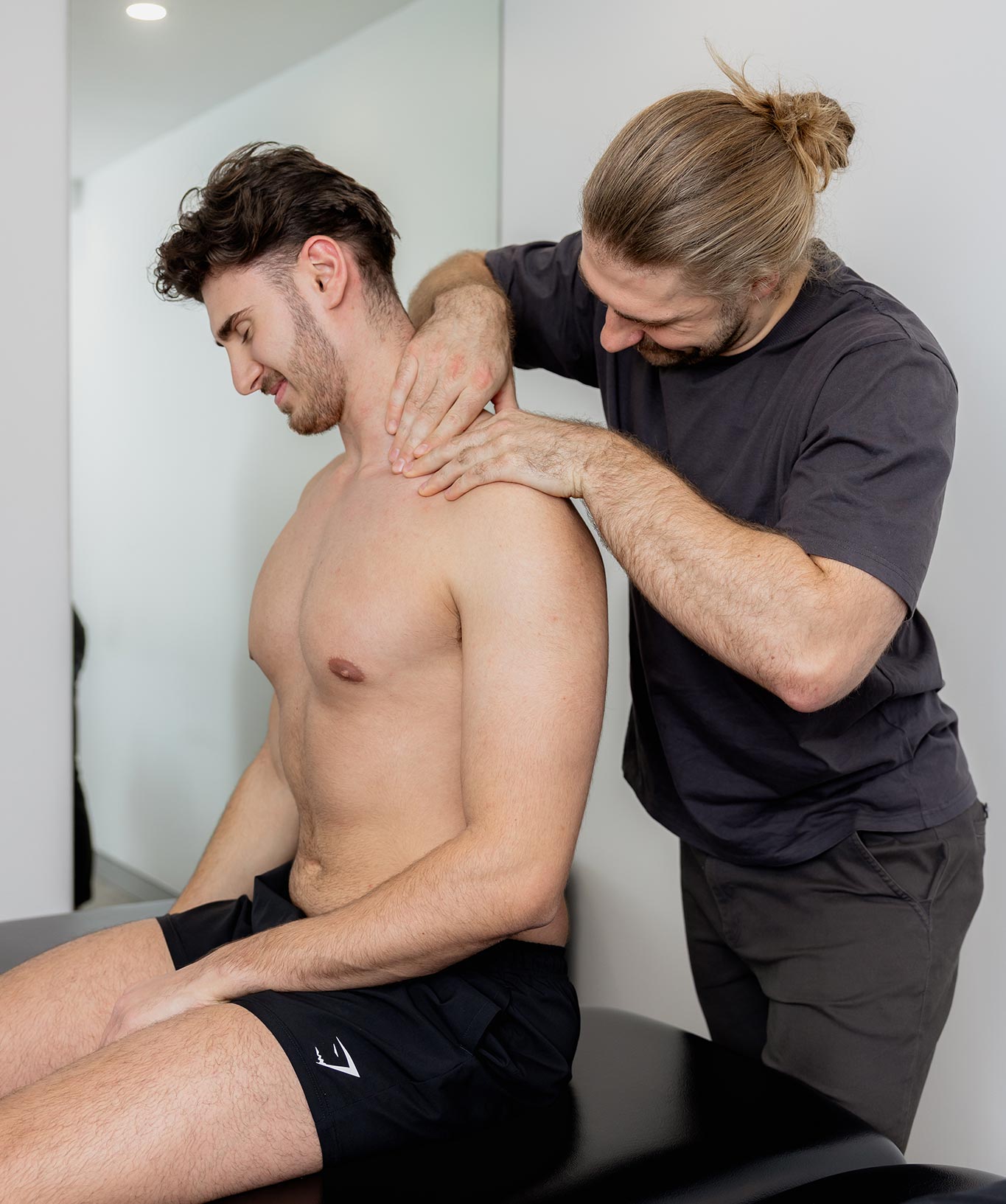
Whiplash is caused by hyperflexion or hyperextension of the cervical and upper thoracic spine, leading to pain and tension in the cervical muscles. This pain can worsen over time and may even restrict head movement. In addition, many people who suffer from whiplash experience vertigo and intense headaches. In rare cases, it can also affect the arm, hand, and fingers, leaving them with less feeling and strength. These symptoms can be caused by a multitude of reasons and require accurate diagnosis and appropriate treatment. Treatment may include massage, dry needling, high-level laser therapy, joint manipulation/mobilisation, and/or stretches–reducing pain and improving movement. Dependent upon initial presentation, the patient may be referred for further investigative imaging such as X-Ray, CT scan or MRI to rule out pathology such as a fracture or disc bulge which can be arranged by our practitioners.
If you suspect you have whiplash it is important to see a health professional to properly diagnose and treat the injury to prevent further complications.
If you are suffering whiplash as a result of a workplace or motor vehicle accident, all of our practitioners are SIRA-accredited for workers compensation or CTP claims.
Working with you on acute whiplash pain
- Goals: Pain relief, improved mobility, better posture and become more functional.
- Problems: What are you experiencing? What is limiting you? How does this impact your life?
- Diagnosis: An in-depth diagnosis following a comprehensive history and examination including in-clinic orthopedic, neurological and functional assessments.
- Design: Your own personalised treatment plan. No one person is the same and you’re not a textbook. Our goal is to arm you with knowledge and awareness so you can better understand your body.
- Doing: Implementing of our modern treatment framework, which is designed to assist you in your recovery.
Whiplash FAQs
If you have experienced a whiplash injury, you must take immediate precautions to avoid certain activities. This will help promote healing and prevent any further damage.
Here are things you should avoid doing after suffering a whiplash injury:
- Physically demanding activities: Prolonged physical activities such as manual labour or sporting activities can cause muscle fatigue and stiffness, severely worsening your whiplash symptoms.
- Sudden or jerky movements: Avoid sudden or jerky movements at all costs, as they can exacerbate your whiplash injury and cause additional pain.
- Avoid sleeping on your stomach: We recommend sleeping on your back or side with a supportive pillow placed either between or under your legs.
- Prolonged driving: You should avoid taking any long trips on the road. If this is unavoidable, we recommend taking frequent breaks to stretch your neck and body.
While most cases of whiplash are mild and can heal independently, some cases can be more serious and require immediate medical attention.
Here are the most commons signs that indicate that your whiplash may be serious:
- Constant headaches after injury
- Severe pain in either the neck, shoulders or upper back
- Difficulty concentrating or recalling recent events
- Dizziness or blurred vision (potential signs of a concussion)
- Neck stiffness or limited range of motion
- Numbness or tingling sensation within the arms, hands or fingers
- Excessively fatigued or having difficulty sleeping multiple nights in a row.
A grade 2 whiplash injury involves the neck’s soft tissues, such as the muscles, ligaments and tendons, being severely stretched and possibly torn.
With proper treatment, a grade 2 whiplash injury can typically take a few weeks to a few months to heal (depending on the severity of the injury).
A grade 3 whiplash injury involves the neck’s soft tissues, such as the muscles, ligaments and tendons, being completely torn or ruptured. This severe injury can also involve fractures or dislocations of the cervical vertebrae and the bones in the neck that make up the spinal column.
Grade 3 whiplash injuries require immediate treatment. While most people can effectively recover from a grade 3 whiplash injury, the recovery time may be long. We recommend speaking with us to assess your whiplash injury appropriately.
Every whiplash injury is different and will require a different type of treatment. Less severe injuries may heal on their own, with grade 2-rated whiplash injuries taking up to a few weeks, to up to a few months to properly heal.
The recovery time for grade 3 whiplash injuries will vary greatly depending on the severity of the injury.
We recommend seeking professional treatment for your whiplash injury as soon as possible.
Our experienced chiropractors can evaluate the extent of your whiplash injury and recommend an appropriate treatment plan. Your treatment plan may include physical therapy, pain medication and, in some cases, wearing a neck brace or other supportive device to help assist your neck.
Proper diagnosis and treatment can help prevent further injury complications and improve your overall quality of life.
Let's Talk ...
Shop 3B/9 George St, North Strathfield NSW 2137
Monday 8am - 6pm
Tuesday 8am - 7pm
Wednesday 8am - 6pm
Thursday 8am - 8pm
Friday 8am - 5:30pm
Saturday 7am - 1:30pm

How We Treat Whiplash
At Continuum Health & Performance, we use a combination of evidence-based treatments tailored to your condition and goals. Relevant treatments for whiplash include:
Frequently Asked Questions: Whiplash
What happens to the body in a whiplash injury?
Whiplash is a rapid acceleration-deceleration movement of the neck, most commonly from a rear-end vehicle collision. This causes stretch and strain of the soft tissues — muscles, ligaments, joint capsules, and sometimes discs and nerve roots. The injury typically affects the lower cervical spine (C4–C6) and can involve multiple structures simultaneously.
How long does whiplash take to recover?
Most people with acute whiplash (Grade I–II) recover within 6–12 weeks with appropriate management. A subset develop persistent symptoms beyond 3 months, known as late whiplash syndrome. Early active management, avoiding prolonged rest and collar use, and maintaining normal activity significantly improves recovery outcomes.
Should I wear a neck collar after whiplash?
Prolonged collar use is no longer recommended and is associated with worse outcomes. Cervical collars can cause muscle deconditioning and reinforce pain-avoidance behaviours. Brief use in the first 24–48 hours for comfort is occasionally appropriate, but early gentle movement and activity resumption leads to faster recovery.
What are the red flags after a whiplash injury?
Seek immediate medical attention if you experience arm weakness or numbness, severe or worsening headache, difficulty swallowing or breathing, loss of consciousness, or significant neck stiffness with fever. These may indicate more serious injury to the spinal cord, blood vessels, or suggest a fracture.
Can whiplash cause long-term problems?
While most people recover fully, a significant minority develop chronic whiplash-associated disorder (WAD). Risk factors for poor recovery include high initial pain intensity, significant psychological distress, catastrophising, and delayed or inappropriate early management. Early targeted treatment and active rehabilitation are the most effective strategies to prevent chronicity.
Related Conditions We Treat